Best UK Nature Retreats for Seabird Watching in Spring
By late March the cliffs are already loud. Guillemots pack the ledges, gannets swing past on stiff wings, and the first puffins bob on the water below their burrows before hauling themselves ashore. Spring is short and frantic on the UK coast, and the best colonies are also the busiest, so the gap between a wonderful morning and a frustrating one usually comes down to planning. Here is where to go, what to expect, and how to watch without adding to the pressure these birds are already under.
Getting the timing right
Arrivals stagger, and knowing the order saves wasted trips. Puffins are usually back from late March, with the most rewarding weeks running from mid-April to mid-June; by early August many have returned to sea. Gannets never truly leave their colonies, but courtship and nest-building in March and April give you the closest views of birds bowing, fencing bills and cosying up on impossible ledges. Terns turn up later, often from late April, and settle to nest in May — which is also when they become fiercely territorial.
Two practical rules apply almost everywhere. Go early: colonies are at their most active in the two hours after dawn, and the wind is usually lighter. And check the forecast the night before, not the morning of, because boat operators cancel for swell rather than rain. A flat, bright morning after a windy week is often exceptional, as birds that have been sitting tight come out to feed.
Cliff-top classics: Yorkshire and the north-east
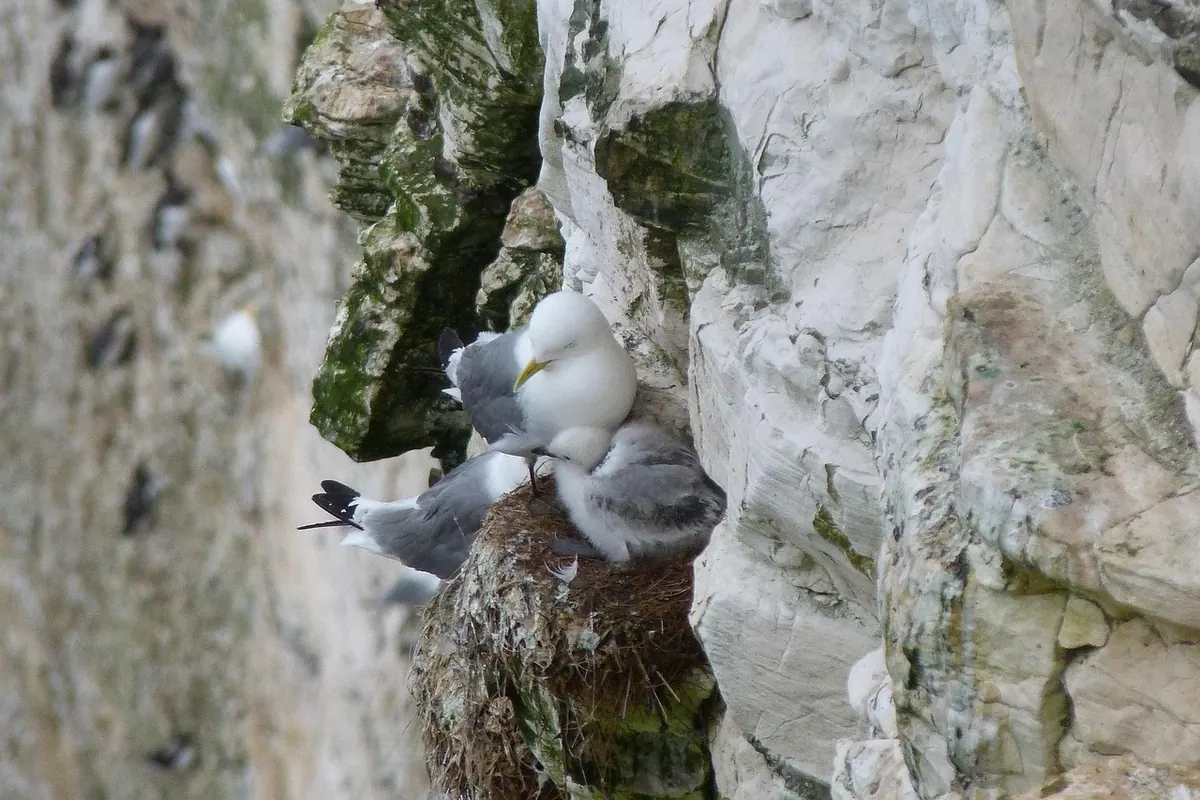
The easiest introduction to seabird watching in Britain is a clifftop path, and the Yorkshire coast does it better than anywhere. At RSPB Bempton Cliffs, between Bridlington and Filey, chalk buttresses hold gannets at genuinely close range, alongside razorbills, guillemots, fulmars and kittiwakes. Puffins are here too, but in smaller, scattered numbers than on the islands — look for them on the grassy clifftop in early morning, when they stand about outside their burrows before heading out to fish.
Further north, Aberdeenshire offers two very different days out. RSPB Troup Head is a mainland gannetry, with birds nesting on sea stacks you can watch from the cliff path; RSPB Fowlsheugh, near Stonehaven, is a narrow, noisy ribbon of guillemots, razorbills and kittiwakes on sandstone. Base yourself in Stonehaven, or in one of the tiny villages such as Crovie or Pennan if you want the sea outside the window.
Islands, and where to stay beside them
Islands concentrate birds, and usually limit visitors, which is why they feel special. In Pembrokeshire, Skomer holds tens of thousands of puffins and is reached by boat from Martin's Haven; landings are capped and must be booked ahead through the Wildlife Trust. Skokholm, its neighbour, is smaller and quieter, and offers simple hostel-style overnight stays — a rare chance to wake up inside a colony, with Manx shearwaters returning after dark.
Other stays worth building a trip around:
- Lundy, in the Bristol Channel, where puffins are slowly recovering and the Landmark Trust lets you stay in everything from a lighthouse to a fisherman's cottage.
- The Farne Islands, off Seahouses in Northumberland, with puffins and raucous tern colonies a short boat ride from the harbour.
- The Isle of May, in the Firth of Forth, reached from Anstruther or North Berwick — puffins, guillemots and terns on a compact, walkable island.
- Rathlin Island, off County Antrim, with puffins, guillemots and a seabird centre on the cliffs above the harbour.
Book boat crossings weeks ahead in May and June. Landings at some reserves have been paused in recent years during avian influenza outbreaks, so check the reserve's own updates shortly before travelling rather than relying on an old blog post.
Gannet cities
Nothing prepares you for a gannetry at close quarters. Bass Rock, three miles off North Berwick, is one of the largest northern gannet colonies in the world and is white with birds in spring; landing is not permitted, but boat trips from the harbour circle it, and the smell and noise carry across the water. For a mainland alternative with fewer logistics, Troup Head in Aberdeenshire works well. Grassholm, off the Pembrokeshire coast, is another gannet stronghold best seen by boat from St Davids, and in Shetland the cliffs of Noss, reached by a small ferry from Bressay, combine gannets with great skuas.
Terns: smaller, sharper, and best watched in a hat
Arctic and common terns are beautiful and completely unafraid of making their point. At Cemlyn Bay on Anglesey, sandwich, Arctic and common terns nest on the shingle ridge beside a brackish lagoon; the North Wales Wildlife Trust asks visitors to stay on the marked path and give the colony room. Coquet Island in Northumberland, home to roseate terns, is a no-landing reserve watched from boat trips out of Amble. Brownsea Island in Poole Harbour is a gentle place to see sandwich and common terns over the lagoon, and the Farne Islands offer the full experience — including the traditional peck on the scalp as you walk through.
Keep moving steadily through a tern colony, wear a hat, and resist waving your arms. Birds are defending eggs and chicks, not you, and the sooner you are through, the sooner they settle.
Watching well: etiquette that actually matters
Disturbance is cumulative. A single photographer flushing a puffin off its burrow matters little; fifty doing it over a weekend can cost a colony eggs and chicks. Simple habits make the difference:
- Stay on the path. Puffin burrows collapse underfoot, and cliff-edge soil is fragile.
- Keep your distance and let optics do the work. Binoculars or a spotting scope beat creeping closer every time.
- Leave the drone at home. Most reserves ban them outright, and birds react badly to the noise.
- Keep dogs on a short lead, or leave them behind on island days.
- Never feed birds or use bait to attract them for photographs. It changes behaviour and pulls birds off nests.
- Follow warden instructions without argument, including closed paths and no-landing signs.
- Report a ringed bird to the British Trust for Ornithology rather than handling it, and tell reserve staff about any obvious disturbance you see.
Planning the trip: kit, boats and conditions
Pack for four seasons in one day. A waterproof shell, warm mid-layer, hat and gloves will earn their place even in May, and a scarf over your ears makes cliff-top wind bearable. Binoculars of 8x42 are the sensible default; a scope is a luxury on cliff paths where weight matters.
Take cash or a card for harbour car parks, arrive early for boats as they rarely wait, and keep an eye on tide times if you plan to walk below cliffs — several popular routes are cut off by the tide. Take your litter home, and leave the cliff edge alone: the view is better from a metre back anyway. With a bit of forethought, a spring morning on the coast delivers one of the great free spectacles of the British Isles.
Photo: Meatle / Pixabay